
THE FATIGUE THAT COFFEE DOESN'T FIX — AND THE MINERAL COMPOUND THAT ADDRESSES WHAT'S ACTUALLY MISSING (When your energy runs on empty even after sleep, the problem is cellular — not motivational.)


There's a type of fatigue that sleep doesn't fix and caffeine only masks. You wake up unrested. You push through the morning on stimulants. By early afternoon, something drains out of you that no second coffee fully restores. This pattern has a name in nutritional research — and it has almost nothing to do with how many hours you slept.
THE FATIGUE THAT DOESN'T RESPOND TO SLEEP
There are two fundamentally different kinds of tired, and most people spend years treating the wrong one. The first kind responds to rest. You're exhausted because you pushed hard — a demanding week, poor sleep, intense exercise. You rest, you recover, you're back.
The second kind doesn't resolve. It's there in the morning before the day starts. It's the mid-afternoon cognitive slowdown that descends like a curtain regardless of how much sleep you got. It's the sense that your baseline energy is just lower than it should be.
Caffeine affects both kinds differently. For normal fatigue, caffeine provides useful, temporary relief. For cellular fatigue, caffeine creates a loan: it blocks adenosine receptors, masking exhaustion without addressing its source. The debt comes due in the afternoon crash.
Nutritional research increasingly traces this pattern to trace mineral insufficiency — the cofactors that mitochondria require to produce energy efficiently and that modern food supply no longer reliably delivers.
THE CELLULAR REALITY — MITOCHONDRIA AND ATP
Every cell in your body runs on adenosine triphosphate — ATP. It's the universal energy currency: muscle contractions, cognitive processing, immune function, hormone regulation — all of it runs on ATP produced by the mitochondria.
Mitochondrial ATP production isn't a simple chemical reaction. It's a multi-step biochemical cascade that requires a precise set of cofactors to function efficiently. These cofactors include magnesium, iron, copper, zinc, manganese, and dozens of other trace minerals. When any of these are insufficient, the cascade slows. Cells produce less ATP.
The deficit is not a rarity. A study published in the Journal of the American College of Nutrition (Davis et al., 2004) analyzed USDA food composition data and found statistically significant declines in key minerals. Crops grow faster than their root systems can absorb minerals from increasingly depleted soil. The trace mineral intake required for optimal mitochondrial function may be systematically lower in modern diets than at any point in recent agricultural history.
WHAT SHILAJIT ACTUALLY IS
Shilajit is not a supplement in the conventional sense. It is not an extract, an isolate, or a synthesized compound. It is a mineral resin — formed over thousands of years as organic plant matter decompresses under the weight of Himalayan rock at altitudes above 18,000 feet. The result is a dense, tar-like substance that concentrates a broad spectrum of naturally occurring minerals, trace elements, organic compounds, and — most significantly — fulvic acid.
Fulvic acid is what distinguishes shilajit from a standard mineral supplement. It functions as a molecular carrier: a small organic acid with an unusually high ion-exchange capacity that transports minerals across cell membranes, enhances their bioavailability at the cellular level, and facilitates their uptake into mitochondria.
THE RESEARCH
A randomized, double-blind, placebo-controlled trial published in the Journal of the International Society of Sports Nutrition followed 63 recreationally active adults over 8 weeks. Subjects supplementing with 500 mg/day of purified shilajit showed significantly reduced fatigue-induced decline in muscular strength compared to placebo. Authors attributed the mechanism to shilajit's "potent electron transfer capacity" supporting mitochondrial energy status.
On ashwagandha: The cortisol-modulating component has a more extensive human clinical record. A double-blind, placebo-controlled study found that 600 mg/day of full-spectrum ashwagandha root extract reduced serum cortisol by approximately 27.9% over 60 days. A separate RCT found significant improvements in sleep efficiency and overall sleep quality.
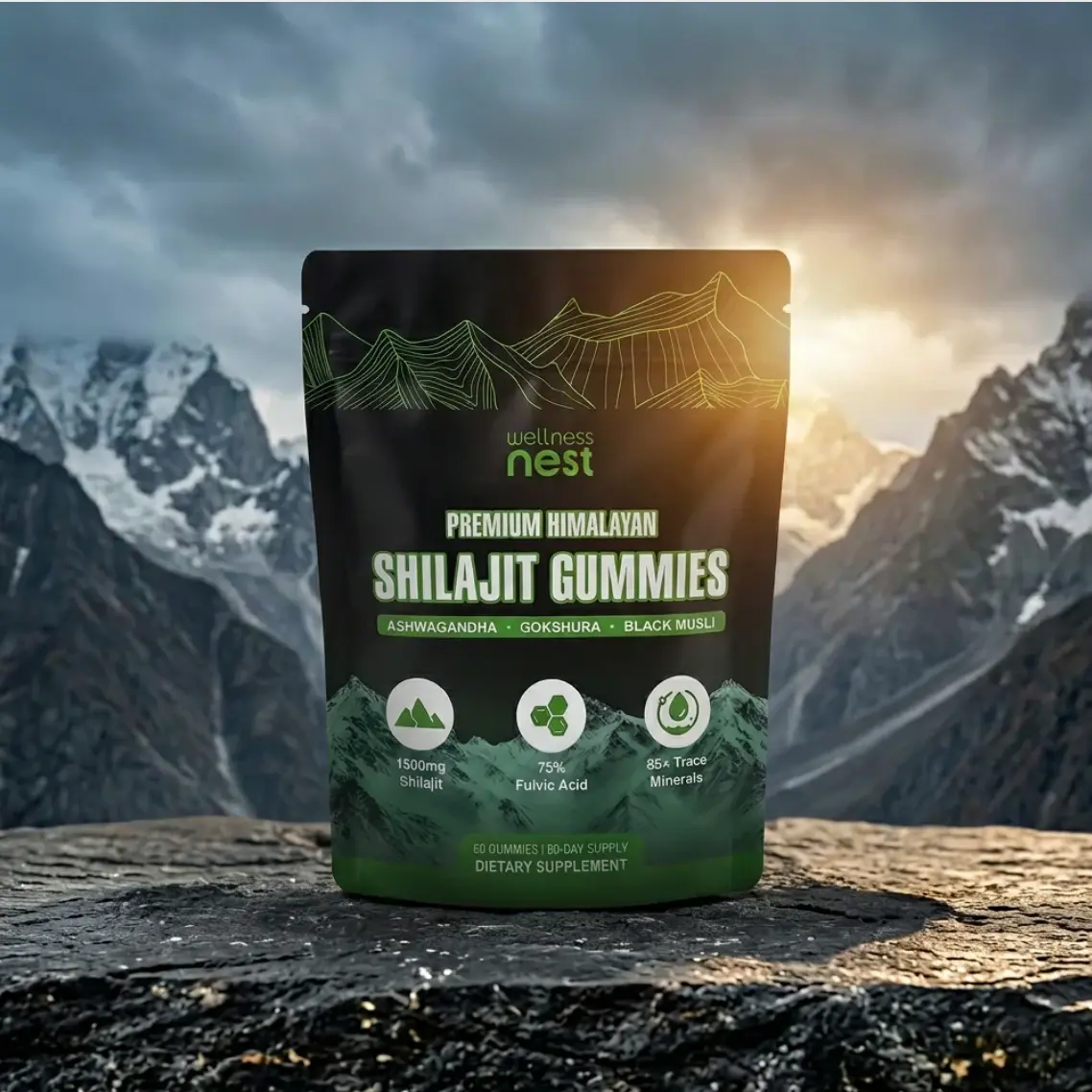
WellnessNest Shilajit Gummies
~$49.99/bottle- check_circle 1,500mg purified compound (75% fulvic acid)
- check_circle With clinical-dose Ashwagandha
- check_circle Eurofins third-party tested for heavy metals
WHY WELLNESSNEST SPECIFICALLY
WellnessNest's Premium Himalayan Shilajit Gummies deliver 1,500mg of purified Himalayan shilajit standardized to 75% fulvic acid per serving. The formula combines shilajit with seven additional herbs in the Ayurvedic Absorption Pathway: ashwagandha, Panax ginseng, ginger, Black Musli, Gokshura, Kaunch, and Akarkara.
Third-party testing is conducted batch-by-batch at Eurofins. Heavy metals are tested to below 1 ppm or not detected — a critical specification for shilajit, where inadequate sourcing can introduce lead, arsenic, and mercury.
The gummy format solves the primary compliance problem with shilajit resin: the intensely bitter, sticky resin format has friction high enough that most people discontinue it within weeks. A gummy with 1 gram's worth of mineral complex per piece removes every barrier.
THE RECOVERY STACK NARRATIVE
WellnessNest Shilajit works as a standalone daily protocol or as part of a broader recovery stack.
For energy and stress recovery, the ashwagandha and shilajit combination addresses two distinct mechanisms: the cortisol load that disrupts recovery and sleep, and the cellular energy deficit that limits daily capacity.
For performance and recovery, shilajit pairs logically with creatine. Creatine directly expands the ATP-regeneration ceiling via the phosphocreatine system; shilajit supports the mitochondrial efficiency that generates baseline ATP from food. They address different stages of the cellular energy pathway and have no known interactions.
"Six weeks in and the headline change is this: I no longer hit the 2pm wall. I've been a three-coffee-a-day person for years and I'm down to one in the morning without feeling like I'm fighting through the afternoon."
Clinical Q&A
How long before I feel a difference? expand_more
Is this safe for women? expand_more
Can I take this alongside creatine or other supplements? expand_more
How do I verify the heavy metal testing? expand_more
I'm sensitive to caffeine. Will this affect my sleep? expand_more
What Users Actually Report
"I added this to my stack alongside creatine about six weeks ago. The recovery difference is real — I'm training more frequently and the soreness between sessions is noticeably less. I was expecting an energy boost, which I got, but the faster turnaround between hard training days was the bigger change."
— Review via Trustpilot (Male, recovery focus)
"I'm a physician and I'm careful about what I take — I looked at the third-party testing before ordering. Three weeks in and I'm sleeping more deeply than I have in months, and my energy through a full day of clinical work is steadier. The science behind ashwagandha for cortisol is solid. No regrets."
— Review via Trustpilot (Female, sleep and stress)
"Six weeks in and the headline change is this: I no longer hit the 2pm wall. I've been a three-coffee-a-day person for years and I'm down to one in the morning without feeling like I'm fighting through the afternoon. The energy isn't a buzz — it's more like a floor that's higher than it used to be. Subtle but consistent."
— Review via Trustpilot (Energy sustainability)
Support the Energy System Caffeine Can't Reach
1,500mg Himalayan shilajit · 75% fulvic acid · Eurofins batch-tested · 90-day guarantee
90-day money-back guarantee (14-day minimum use) · We earn a commission at no extra cost to you